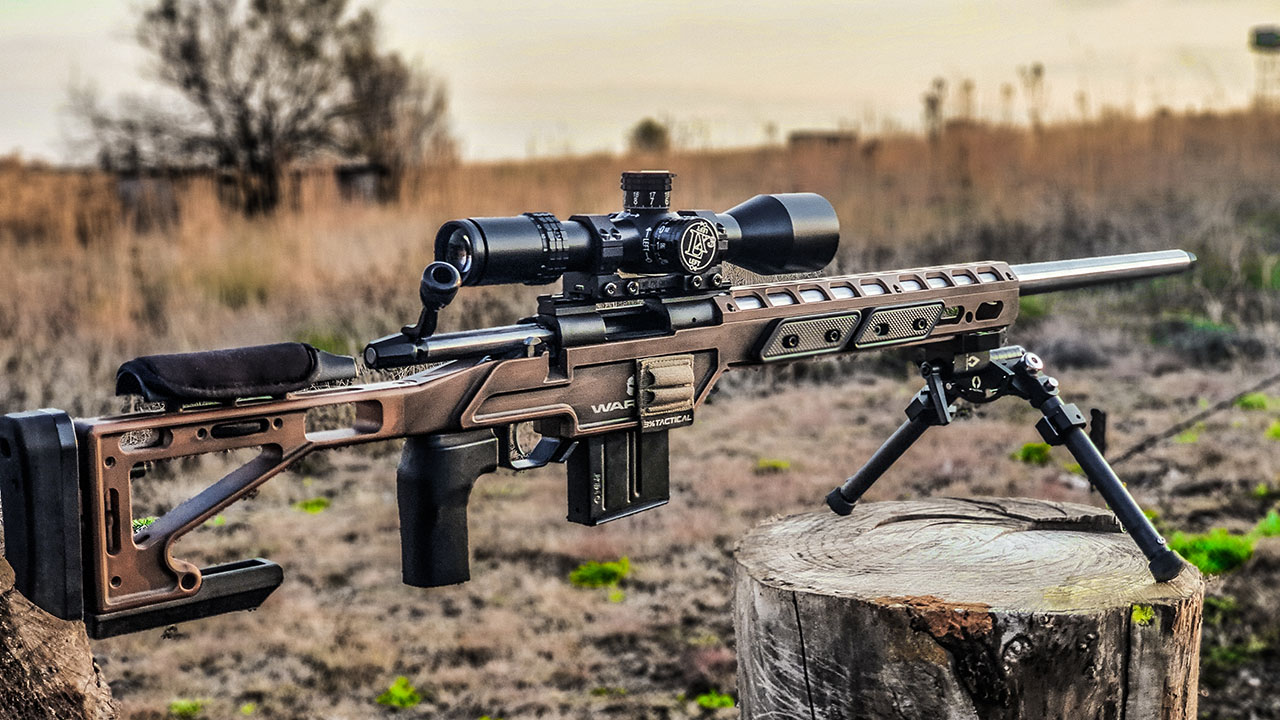
A review of Lynx LX3 4-25x50 FFP MRAD
- by JC Robertson. July-2023
Introduction
Lynx optics has been a mainstay in the domestic hunting and shooting market for as long as I can remember. The landing page on their website reads “Proudly serving South African shooters since 1984” and it is undoubtedly so! Proper Japanese made optics, well suited to their intended purpose, rugged and reliable.
It sure also does no harm that the brand has always been backed by one of the best warranties on the off chance something goes wrong, as a well-trained (local) team dedicated to seeing that repairs are executed is never more than a phone call away.
More recent times saw them expanding their stellar hunting line-up with some competition specific offerings, yet there was nothing catering to the specific needs of those active in the Long Range (LR), Extreme Long Range (ELR) and the more dynamic Precision Rifle Series (PRS) disciplines.
With the growing popularity of these shooting sports, as well as the spike in demand for First Focal Plane (FFP) optics with both the reticle and turrets functioning in milliradian (mrad) measurements, the team at Lynx took on the challenge of designing an optic to supplement their product offering to cater to such shooters.
Local experts and enthusiasts were consulted, and brainstorming done with the experts at Japanese optics powerhouse, Light Optical Works (LOW), to make something happen. The key design criteria for this new product were to offer a robust and reliable optical instrument, as well as a feature-set tailored to the niche needs of the shooting sports previously mentioned.
The new flagship LX3 needed to offer:
- Upgraded optical performance,
- Mrad adjustments and FFP reticle,
- Reticle well suited to both dial-to-dope and hold-over styles of shooting,
- Tactical (exposed) turrets with a rugged and reliable return to zero, as well as
- Significantly upgraded adjustment range for both elevation and windage, and a move towards toolless controls.
The fruit of this labour was the exciting new Lynx LX3 4-25x50 FFP MRAD.
Overview
The result was a 50cal recoil rated, wonderfully compact riflescope measuring only 336mm, sporting a 34mm main tube, 50mm objective lens and tipping the scales at a mere 970g. Furthermore, it has the reticle positioned in the First Focal Plane (FFP) and both the reticle and turrets subtended in the milliradian (mrad) angular unit of measurement.
For the laymen out there, this simply means the reticle subtends at consistent values throughout the available magnification range (4-25x) and the actual click value is 1cm (10mm) at 100m.
I briefly saw an early ‘working prototype’ at a Precision Rifle Series (PRS) open day at Hippo Creek shooting centre during February 2022. Initial impressions were positive and warranted a more detailed look, unfortunately I got busy and sadly was unable to make proper use of the opportunity. After some following up Michael Rogers from Lynx offered to send me a sample for long term evaluation as soon as it was sent back from another review.
It felt like a lifetime, but sure thing Mike kept his word and soon I was sent one of these exciting new optics to test and evaluate. Instructions were clear, there were no strings attached, the only request was to run it hard for as long as I like and to offer some objective and truthful feedback after doing so.
Truthfully, I was a bit underwhelmed by the only other review published on the optic, mostly due to the fact it circled around general specs and how it looks on paper, rather than anything insightful or revealing as it relates to its realworld performance. I made a commitment to use my time with it wisely, dive deep and offer some relevant, real world opinions and sincere perspectives after subjecting it to thorough evaluation.
It was important for me to run it through its paces in a wide variety of relevant applications, scenarios and conditions to discover strengths, find where it is most effective (applicable) and of course see if potential areas exist where further improvements may be possible.
So, I learned enough on why it came about, and now needed to see how it came togetherand whether it lived up to the hype which surrounded it.
I set about mounting the scope on my trusty 6mm BR PRS rifle and went about testing it in as many positional scenarios I was able to. The plan was to run it hard and see how easy it was to get the gun zeroed, explore how well it tracked out to moderate distances and then how it returned to zero.
Emphasis was placed on how the eye box and field of view (FOV) enabled effective target acquisition, as well as hold over / under drills, which are often used to become more effective at managing time under stress. Equally important was to employ proper fundamentals with a view to managing recoil to allow the spotting of impacts (or misses) and make the required corrections in real-time.
With the dynamic PRS section of my test completed, I switched gears to explore its compatibility in medium to long range scenarios as well as to see how accurately and predictably it tracked through the available adjustment range.
To accomplish this the LX3 FFP MRAD was migrated over to my 7mm SAUM for some long-range work. This was conducted almost exclusively from the prone, shooting paper targets inside 700 m and gongs out to 2000 m.
Optical Performance

From the get-go I will admit that I have been fortunate enough to have owned and used some of the best long range tactical scopes money can buy. Not to brag, the main reason has always been to better understand how different manufacturers approach similar challenges and of course a more complete database for when comparisons must be made.
A valuable lesson was that optical performance is a give and take type deal, in order to boost a specific attribute, something else may have to be sacrificed. For instance, prescriptions aimed at maximizing resolution will not render the brightest image whereas those aimed at maximizing contrast will render a brighter image with a slightly lower resolution.
What you see and how you see it. A very simple explanation on contrast and resolution: Imagine a bird at distance. Contrast will allow you to see this bird where it is, but resolution would then enable you to further identify the specific species or gender.
Furthermore longer (overall length) scopes are widely accepted as better overall performers where those which are more compact are quite a lot more difficult to pull off. This is referenced in line with optical performance not so much overall build quality.
Of course the practical implication is that no single optic in production today will be the best in all the respective (measurable) performance categories. As a result it is of critical importance to know from the onset what the scope will be intended for and to ensure the performance is optimised in those areas which matter most.
Japanese optics have traditionally been quite good optically, especially those upper middleend to top end offerings containing ED / HD lens elements and broadband coatings. Furthermore, they are generally accepted as being more contrasty and offer a white and bright optical experience with vivid, true to life colour rendition.
Edge to edge clarity is normally excellent, and the low light performance more than acceptable as a result of the above average contrast performance. For all this they tend to resolve a fair bit less than their European counterparts, have narrower field of view (FOV) and be more susceptible to colour fringing, better identified as chromatic aberrations (CA). The effect is most visible when your eye is not perfectly centred in the eyepiece or when used in high contrast environments.
In this optic the optical engineers have done well to keep the best of what’s generally expected from Japanese offerings, whilst simultaneously boosting the resolution by noticeable amounts and simultaneously finding a way of managing CA extremely well. The design team have hit the ball out of the park with the next generation HD glass and latest lens coatings incorporated into this riflescope.
Life behind this scope spoils the shooter with a perfectly flat, true to life image whilst remaining sharp from centre to the edges. Truthfully, it's still more contrasty with resolution a tad behind the true "Alpha Tier" contenders although you can still easily see all that's necessary to make that shot of a lifetime or be competitive at the upper performance tiers. This Lynx LX3 FFP MRAD offers an unashamedly pleasurable optical experience, which is more impressive seeing I was already expecting it to be good.
Mirage performance - You can only hit what you can see, and dealing with mirage often has you either aiming where the target is not or not precisely aiming where it is. It seems mirage performance is somehow linked to an optical designs depth of field (DOF) performance. Simply put DOF is the range which is in sharp focus and parallax free for any given side focus setting. As a result optical engineers have worked to add depth to an image to feed more information to the human eye and brain. The LX3 FFP MRAD offers above average mirage performance. A good balance has been struck between seeing enough mirage for hints on what the wind is doing downrange while simultaneously cutting through it sufficiently well to not suffer a washed-out (distorted) image.
Better yet, the optical performance is very surprising when considering the form factor (compactness) of the scope. Short riflescopes are terribly difficult to manufacture well, often suffering a very shallow depth of field, a constrained (tight) eye box and lacking overall image quality. The Lynx LX3 FFP MRAD exhibited no serious issues with any of these. Quite astonishing then to see what the LOW engineers have managed with this specific design.
As with every other scope in existence the image does darken as you approach maximum magnification as the exit pupil reaches its minimum value and this was no different. Best performance is found up to 22 or 23x after which the image starts to darken, and the generally fabulous eye box also becomes a bit tighter.
Something particularly worthy of mention is the optical and mechanical performance when the erector is up against the limits of movement. As a rule, care needs to be applied when a rifle scope is adjusted to the extreme edges. To ensure proper focus is maintained an adjustment to the side focus will be required, also, image performance and depth of field become compromised as one moves further away from the sweet spot in the middle of the lenses. With the Lynx LX3 the limits on both ends of the elevation range still provide a nice flat image, the eye box remains forgiving (23x and under) and it still adjusts more than 10mils of windage left and right.
Mechanical performance

With all the optics talk going about it may be good to remember that this is only half of the story. A precision rifle optic first needs to be durable, reliable and precise before glass quality really means anything.
On the mechanical side of things, I was particularly impressed. The accuracy and repeatability of the individual click values throughout the elevation range, as well as the ability to return to the exact same zero every time will make or break a long-range optic.
After bore sighting and using the reticle to make the required correction to zero up, I managed to find the bull with that second shot. Not once but several times. Of course a scope has to maintain this performance after more adjustments are made but after seeing how the Lynx adjusted I was confident that the mechanical precision was something special.
In a scope some things need to move and others not. So, I set about testing to see if there was any detectable reticle movement when dialling through the magnification range and was able to detect none. Multiple samples (tests) showed the same group shape and position relative to point of aim when testing return to zero capability.
The .35mil centre dot remained in a consistent position all the way from 4x through 25x and back, on numerous occasions, in different lighting and environmental conditions and in different provinces. It consistently held zero and tracked true to the predicted dope with borderline boring consistency throughout the months I have spent with this specific unit.
Once the side focus (some call it parallax) was properly set the only way to get reticle movement was to wrench on those nice big turrets. And when doing so with the optic mounted on a jig and measuring reticle movement on a mill-based grid the tracking was metronomically accurate from one stop to the other and back.
Smoothness and overall feel of controls - No issues to report here. It's par for the course when considering this is a proper LOW made optic. All dials (mag, side focus and diopter) were set to an ideal tension level, and remained consistent throughout differing temperature ranges, impressively consistent throughout. Another one of those "small" things which inspire confidence that the scope is an instrument to be trusted.
Turrets - now this is one of those subjective elements. No two individuals experience (or prefer) this the same way. But straight out of the box, the feel and sound of these Lynx turrets got under my skin. A wonderful sensory experience, the balance struck between each click spacing, the feel and the noise it makes just appealed to me in a remarkable way and inspired confidence.
The 'tactile click' is one of those massively overused cliches, but these are nothing but that. Of course I could care less what they felt and sounded like if a single click did not yield the .1mil indicated on it. Luckily the results calmed my sceptical mind, and I soon realised the Japanese turret mechanism is to be trusted. Not only for one, or a few clicks, but throughout the entire range and all the way back to zero.
Multiple rounds shot out to a mile, and various distances in-between, almost boringly returned to a perfect zero every single time. Not only that but it also held zero from day to day and range to range far better than I ever could have imagined. I lost count of how many sub .3moa groups were shot in different settings, atmospherics, lighting conditions etc. all impacting precisely where the centre dot of the reticle was aimed.
Toolless re-zero - Many consumer decisions are driven by convenience and ease of use. One welcome upgrade here is the ability of the end user to remove and re-zero both the elevation and windage turrets without requiring any tools. Simply unscrew the top cap, slip the turret to the desired setting and tighten the cap again. Simplistic bliss.
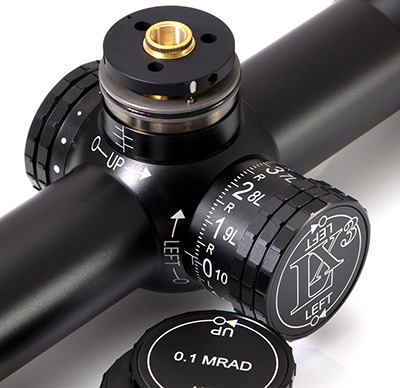
Zero stop - Following the above, the setting of the zero stop follows the "if it ain't broke, don't fix it" philosophy. Either that or simplicity being the ultimate sophistication. This scope employs a time-tested Japanese design. Once the turret cap has been removed, you find a collar seated on the elevation post with 3 grubscrews. This then interfaces a brass post at the predetermined setting for a hard stop. What's left is to select your preferred number under zero, move the collar clockwise till it stops and tighten down the grubscrews. All that's left to do is to put the turret cap back and lock it down for a rock solid zero stop.
Unlike some of the more modern systems this allows the user to select the preferred overrun amount. For instance, 2 mils (20x clicks) under actual zero for hold under application or even to capitalise on the Accuracy 1st speed drop formula for rapid target engagement. It worked well throughout and in many years of using this system it has never failed or faltered.
A Sponsorship agreement prohibits me from ever running this specific optic in competitions, but I would have happily done so. Have I used / owned scopes that best the LX3 FFP MRAD in individual performance categories? I have, but the Lynx then gets ahead of it by being such a well-rounded performer. Of course at the cost it's downright untouchable!

Reticle - One of the biggest factors in play when first impressions are formed when looking at a scope would be the reticle. Of course the intended use will dictate the style of reticle in play, but you really have but a few seconds to either fall in love with the reticle, or not. The reticle found in the LX3 FFP MRAD was obviously designed with long range shooting and precision shooting sports in mind. It's a functional hold-over style reticle striking a good balance with how it presents throughout the magnification range by means of an adaptive thickness design. In addition, it has a slim Xmas tree pattern dropping steeply at 32° from the centre dot to the periphery of the sight picture. This is helpful for hold-over style shooting, or for measuring corrections in real time. On the horizontal (windage stadia) you have the popular .2 holds, same on the elevation stadia. Supplemented by a fine, .35mil floating centre dot for razor sharp aiming precision and for as little obstruction of the target as possible. Another nice feature is the fact that the elevation stadia extending upward past the centre dot has been limited to 1 mrad as to unclutter the upper field of view and allow for improved sighting / spotting. Overall feel looking through the scope is this reticle offers all the required help without being overly 'busy'.
Summary and recommendations
I love the compactness of this specific scope, more so how the engineers worked around the challenges which come with designing compact riflescopes and somehow managed to overcome most of them.
The depth of field was quite good, ease of setting the zero stop and how easy they made re-zeroing. The turrets are fantastic, not only how they feel, but the tracking precision and repeatability. As well as of course the unbelievably wide range of adjustment offered and the general versatility as a result. Overall image quality compares well with more expensive and widely respected scopes.
Furthermore, the generous eye box makes the LX3 FFP MRAD a wonderfully versatile optic. On the big boomers (ELR calibres) there is no fear of the dreaded "kiss" and when used in weird positional shooting disciplines, PRS for instance, you have extra forgiveness for every possible prop / challenge encountered. I detected minimal change in actual eye relief when moving through the magnification range allowing the setup to remain unchanged for a variety of applications.
Close in focus distance - with the skyrocketing cost of shooting related gear I find more end users needing their gear to serve cross-over roles. Optics often serve on multiple weapon systems. It's not uncommon for a scope to be utilised on both a centrefire weapon as well a PCP airgun or rimfire. The 20 m minimum focus distance makes this scope well suited to these weapon types and styles of shooting also, and of course indoor dry fire exercise.
I'm amazed at the total amount of mechanical adjustment (elevation as well as windage) available in this 34 mm scope. The unit I used offered 48 dialable mrad units (over 160 MOA). Of course it only really means something if the adjustments are accurate and repeatable and try as I might there is no faulting this system's mechanics.
Standouts for me are the compact footprint, the enormous adjustment range, the closein focus distance and the ease with which it is re-zeroed. Furthermore, its optical and mechanical performance rival riflescopes costing tens of thousands more.
Areas which could possibly be improved upon
Truthfully there is not much to get into here, but in the spirit of full transparency and the drive for continuous improvement I will mention what some could see as areas for betterment.
Much as I understand what was attempted with this reticle, I would love to see the horizontal (windage) stadia maintain the .5mil subtension used throughout. Also, for the elevation stadia above the centre dot extended to 3mils to offer more assistance for hold-under scenarios. This can be done without sacrificing the open top section of the sight picture and still allow the shooter to catch trace in conditions conducive to it.
Some may argue illumination is necessary, that said I am willing to ignore it seeing this was never intended as being a hunting scope. Truthfully, illumination offers little to no benefit to ELR / LR and PRS competitors but it does add to the cost. I see no immediate need or use for it.
If the design is ever carried into a second generation, I would appreciate it if the zero-stop mechanism was also toolless as it would offer another real-world benefit. As well once it is understood how important it is properly setting up the diopter on one of these modern FFP designs I'd rather have a locking diopter than the fast focus alternatives.
Closing thoughts
This Lynx LX3 FFP MRAD is a highly aspirational riflescope, almost like nobody ever told it when to quit, or how good it should be. It boasts a serious, can-do attitude, backed by a relevant feature set and the performance allowing it to be better than most would believe and far better than the price indicates.
With this LX3 FFP MRAD Lynx unknowingly took one of my all-time favourite workhorse scopes (Bushnell DMR2) and improved it in every measurable way. With progressive optical performance, a superior turret mechanism and a wider adjustment range that expands its appeal to shooters seeking a competitive advantage as well as pushing the distance envelope, not to mention closer in focus distance for dry fire practice or rimfire shooting, this optic has it all.
Certainly, one scope can't offer the best of everything and it's the same here. The FOV is competitive and the DOF (whilst improved) remains on the shallower end of the spectrum. As with most of the Japanese HD lens elements there is a distinct preference given to colour and contrast over resolution performance. It's in scenarios where you really need to be sure what you are seeing where the difference between the LX3 and the true alpha tier optics becomes apparent. But then, at least to my mind, the difference in performance does not justify the cost it comes at and it's debatable if you can convert it to more hits or higher scores.
To my mind the greatest advancements in the optics industry have not really allowed the best scopes to become even better, rather making improvements on what's possible at lower cost. I'm most excited by the performance offered by scopes such as these as they bring superlative performance to the middle-class (average) individual, or even the high-end user who simply chooses to spend available resources more wisely. It brings strong performers to the greater shooting public and in so doing grows the customer base and enables improved performance and overall enjoyment.
This optic aims to not only keep the brand on the cutting edge in a fast-evolving market, but also maintain its reputation as progressive optics supplier offering relevant, well-designed products, respected as being unbeatable performance to value optics.
I'm quite comfortable saying that it has a proverbial "leg-up" when compared to other scopes in this price range. The Delta Stryker and Element Nexus are also very good, worthy of mention for the purposes for which they were designed. That said they simply cannot stand with the Lynx when considering the complete performance package, more specifically the performance to value component.
You really must step up a fair bit in cost to find a scope that will decisively best it in terms of image quality, then only to find it lacks in some of the other important performance categories.
With all said and done special mention has to be made about local support and assistance in the case where something goes wrong. The team at Lynx have an unquestionable reputation as having your back in the case where assistance is required. This manifests in the form of the ability to test, service and repair optics in house rather than having to send them out of the country.
I have full confidence that whoever purchases one of these scopes will also enjoy absolute peace of mind knowing that they own a stellar product and are taken care of by a capable technical team who are on stand-by to ensure the best after sales experience